If Youve Had a Cellulitis Infection Before
| Cellulitis | |
|---|---|
 | |
| Skin cellulitis | |
| Specialty | Infectious illness, dermatology |
| Symptoms | Ruddy, hot, painful area of skin, fever[1] [ii] |
| Duration | 7–10 days[2] |
| Causes | Bacteria[1] |
| Risk factors | Suspension in the skin, obesity, leg swelling, old age[1] |
| Diagnostic method | Based on symptoms[i] [3] |
| Differential diagnosis | Deep vein thrombosis, stasis dermatitis, erysipelas, Lyme affliction, necrotizing fasciitis[1] [4] [5] |
| Treatment | Elevation of the affected expanse[iv] |
| Medication | Antibiotics such equally cephalexin[1] [half dozen] |
| Frequency | 21.2 1000000 (2015)[7] |
| Deaths | 16,900 (2015)[eight] |
Cellulitis is a bacterial infection involving the inner layers of the skin.[1] Information technology specifically affects the dermis and subcutaneous fat.[1] Signs and symptoms include an area of redness which increases in size over a few days.[1] The borders of the area of redness are generally not precipitous and the skin may exist swollen.[one] While the redness often turns white when pressure is applied, this is not always the case.[1] The area of infection is usually painful.[i] Lymphatic vessels may occasionally be involved,[1] [4] and the person may have a fever and feel tired.[2]
The legs and face are the most common sites involved, although cellulitis can occur on any part of the body.[1] The leg is typically affected following a break in the skin.[one] Other take chances factors include obesity, leg swelling, and old age.[1] For facial infections, a intermission in the skin beforehand is not usually the case.[i] The bacteria most normally involved are streptococci and Staphylococcus aureus.[ane] In contrast to cellulitis, erysipelas is a bacterial infection involving the more superficial layers of the skin, present with an surface area of redness with well-defined edges, and more than ofttimes is associated with a fever.[1] The diagnosis is usually based on the presenting signs and symptoms, while a prison cell culture is rarely possible.[1] [iii] Earlier making a diagnosis, more than serious infections such as an underlying bone infection or necrotizing fasciitis should be ruled out.[4]
Treatment is typically with antibiotics taken past oral fissure, such as cephalexin, amoxicillin or cloxacillin.[i] [6] Those who are seriously allergic to penicillin may be prescribed erythromycin or clindamycin instead.[6] When methicillin-resistant S. aureus (MRSA) is a concern, doxycycline or trimethoprim/sulfamethoxazole may, in addition, exist recommended.[ane] In that location is business related to the presence of pus or previous MRSA infections.[1] [ii] Elevating the infected area may be useful, every bit may pain killers.[4] [half dozen]
Potential complications include abscess formation.[1] Effectually 95% of people are amend after 7 to ten days of treatment.[2] Those with diabetes, notwithstanding, often have worse outcomes.[9] Cellulitis occurred in about 21.ii million people in 2015.[vii] In the Usa most ii of every 1,000 people per twelvemonth take a case affecting the lower leg.[ane] Cellulitis in 2015 resulted in about 16,900 deaths worldwide.[8] In the United Kingdom, cellulitis was the reason for 1.6% of admissions to a hospital.[6]
Signs and symptoms [edit]
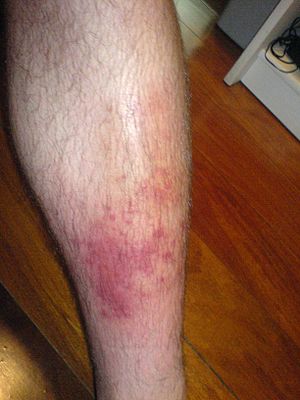
The typical signs and symptoms of cellulitis are an area that is red, hot, and painful. The photos shown here are of balmy to moderate cases and are not representative of the earlier stages of the condition.[ commendation needed ]
-

Cellulitis following an abrasion: Note the red streaking upwardly the arm from the interest of the lymphatic system.
-

Infected left shin in comparison to the right-sided shin with no sign of symptoms.
-

Cellulitis of the leg with pes involvement.
Complications [edit]
Potential complications may include abscess formation, fasciitis, and sepsis.[1] [10]
Causes [edit]
Cellulitis is caused by bacteria that enter and infect the tissue through breaks in the skin. Grouping A Streptococcus and Staphylococcus are the nearly common causes of the infection and may be establish on the skin as normal flora in salubrious individuals.[11]
Nearly 80% of cases of Ludwig's angina, or cellulitis of the submandibular infinite, are acquired past dental infections. Mixed infections, due to both aerobes and anaerobes, are commonly associated with this type of cellulitis. Typically, this includes alpha-hemolytic streptococci, staphylococci, and bacteroides' groups.[12]
Predisposing atmospheric condition for cellulitis include an insect or spider bite, baking, an animal bite, tattoos, pruritic (itchy) peel rash, recent surgery, athlete's foot, dry peel, eczema, injecting drugs (peculiarly subcutaneous or intramuscular injection or where an attempted intravenous injection "misses" or blows the vein), pregnancy, diabetes, and obesity, which can affect apportionment, too every bit burns and boils, although debate exists as to whether pocket-size pes lesions contribute. Occurrences of cellulitis may as well exist associated with the rare status hidradenitis suppurativa or dissecting cellulitis.[13]
The advent of the skin assists a medico in determining a diagnosis. A doc may too suggest claret tests, a wound culture, or other tests to assistance dominion out a blood clot deep in the veins of the legs. Cellulitis in the lower leg is characterized by signs and symptoms like to those of a deep vein thrombosis, such as warmth, hurting, and swelling (inflammation).
Reddened pare or rash may signal a deeper, more serious infection of the inner layers of skin. Once beneath the pare, the bacteria can spread rapidly, entering the lymph nodes and the bloodstream and spreading throughout the body. This can result in influenza-like symptoms with a loftier temperature and sweating or feeling very cold with shaking, as the sufferer cannot go warm.[xiv]
In rare cases, the infection can spread to the deep layer of tissue called the fascial lining. Necrotizing fasciitis, too called by the media "flesh-eating bacteria", is an example of a deep-layer infection. Information technology is a medical emergency.[15]
Risk factors [edit]
The elderly and those with a weakened immune arrangement are especially vulnerable to contracting cellulitis.[ citation needed ] Diabetics are more than susceptible to cellulitis than the general population because of harm of the immune system; they are especially prone to cellulitis in the anxiety, considering the disease causes damage of claret apportionment in the legs, leading to diabetic foot or foot ulcers. Poor command of claret glucose levels allows bacteria to abound more rapidly in the afflicted tissue and facilitates rapid progression if the infection enters the bloodstream. Neural degeneration in diabetes means these ulcers may not exist painful, thus often become infected. Those who have suffered poliomyelitis are also decumbent because of circulatory problems, especially in the legs.[ citation needed ]
Immunosuppressive drugs, and other illnesses or infections that weaken the allowed system, are also factors that make infection more than probable. Chickenpox and shingles often result in blisters that break open, providing a gap in the skin through which leaner can enter. Lymphedema, which causes swelling on the arms and/or legs, can also put an individual at risk.[ citation needed ] Diseases that bear upon claret circulation in the legs and feet, such as chronic venous insufficiency and varicose veins, are as well risk factors for cellulitis.[ citation needed ]
Cellulitis is also common among dense populations sharing hygiene facilities and common living quarters, such as military machine installations, college dormitories, nursing homes, oil platforms, and homeless shelters.[ commendation needed ]
Diagnosis [edit]
Cellulitis is almost often a clinical diagnosis, readily identified in many people by history and concrete examination alone, with rapidly spreading areas of cutaneous swelling, redness, and heat, occasionally associated with inflammation of regional lymph nodes. While classically distinguished as a split up entity from erysipelas past spreading more than deeply to involve the subcutaneous tissues, many clinicians may allocate erysipelas as cellulitis. Both are oft treated similarly, only cellulitis associated with furuncles, carbuncles, or abscesses is usually caused by South. aureus, which may affect handling decisions, particularly antibiotic selection.[xvi] Pare aspiration of nonpurulent cellulitis, usually acquired by streptococcal organisms, is rarely helpful for diagnosis, and blood cultures are positive in fewer than 5% of all cases.[16]
It is of import to evaluate for co-existent abscess, as this finding usually requires surgical drainage as opposed to antibody therapy lone. Physicians' clinical assessment for abscess may be express, specially in cases with all-encompassing overlying induration, but use of bedside ultrasonography performed by an experienced practitioner readily discriminates between abscess and cellulitis and may change direction in upwards to 56% of cases.[17] Use of ultrasound for abscess identification may as well exist indicated in cases of antibiotic failure. Cellulitis has a characteristic "cobblestoned" appearance indicative of subcutaneous edema without a defined hypoechoic, heterogeneous fluid drove that would indicate abscess.[xviii]
Differential diagnosis [edit]
Other atmospheric condition that may mimic cellulitis include deep vein thrombosis, which can exist diagnosed with a compression leg ultrasound, and stasis dermatitis, which is inflammation of the pare from poor blood catamenia. Signs of a more astringent infection such as necrotizing fasciitis or gas gangrene that would require prompt surgical intervention include purple bullae, skin sloughing, subcutaneous edema, and systemic toxicity.[xvi] Misdiagnosis can occur in up to 30% of people with suspected lower-extremity cellulitis, leading to 50,000 to 130,000 unnecessary hospitalization and $195 to $515 one thousand thousand in avoidable healthcare spending annually in the U.s..[nineteen] Evaluation by dermatologists for cases of suspected cellulitis has been shown to reduce misdiagnosis rates and amend patient outcomes.[20] [21]
Associated musculoskeletal findings are sometimes reported. When it occurs with acne conglobata, hidradenitis suppurativa, and pilonidal cysts, the syndrome is referred to as the follicular occlusion triad or tetrad.[22]
Lyme disease can be misdiagnosed as cellulitis. The characteristic bullseye rash does not always appear in Lyme affliction (the rash may not have a key or band-like clearing, or not appear at all).[23] Factors supportive of Lyme include recent outdoor activities where Lyme is common and rash at an unusual site for cellulitis, such as armpit, groin, or behind the human knee.[24] [23] Lyme can besides upshot in long-term neurologic complications.[25] The standard treatment for cellulitis, cephalexin, is not useful in Lyme disease.[5] When it is unclear which i is present, the IDSA recommends treatment with cefuroxime axetil or amoxicillin/clavulanic acrid, every bit these are constructive against both infections.[v]
Prevention [edit]
In those who have previously had cellulitis, the use of antibiotics may help prevent hereafter episodes.[26] This is recommended by CREST for those who have had more than two episodes.[half-dozen] A 2017 meta-assay found a benefit of preventative antibiotics for recurrent cellulitis in the lower limbs, simply the preventative effects appear to diminish afterwards stopping antibiotic therapy.[27]
Handling [edit]
Antibiotics are usually prescribed, with the amanuensis selected based on suspected organism and presence or absenteeism of purulence,[16] although the best treatment choice is unclear.[28] If an abscess is likewise nowadays, surgical drainage is usually indicated, with antibiotics oftentimes prescribed for co-existent cellulitis, especially if extensive.[17] Hurting relief is also often prescribed, merely excessive pain should always be investigated, as it is a symptom of necrotizing fasciitis. Top of the affected surface area is ofttimes recommended.[29]
Steroids may speed recovery in those on antibiotics.[1]
Antibiotics [edit]
Antibiotics choices depend on regional availability, but a penicillinase-resistant semisynthetic penicillin or a first-generation cephalosporin is currently recommended for cellulitis without abscess.[16] A course of antibiotics is not constructive in betwixt six and 37% of cases.[30]
Epidemiology [edit]
Cellulitis in 2015 resulted in nigh xvi,900 deaths worldwide, up from 12,600 in 2005.[eight]
Cellulitis is a common global health burden, with more than 650,000 admissions per year in the United states of america lonely. In the United States, an estimated fourteen.5 million cases annually of cellulitis account for $iii.7 billion in ambulatory care costs alone. The majority of cases of cellulitis are nonculturable and therefore the causative bacteria are unknown. In the 15% of cellulitis cases in which organisms are identified, well-nigh are due to β-hemolytic Streptococcus and Staphylococcus aureus.[31]
Other animals [edit]
Horses may acquire cellulitis, usually secondarily to a wound (which can exist extremely pocket-sized and superficial) or to a deep-tissue infection, such equally an abscess or infected os, tendon sheath or joint.[32] [33] Cellulitis from a superficial wound usually creates less lameness (grade 1–two of 5) than that caused by septic arthritis (course 4–5). The horse exhibits inflammatory edema, which is hot, painful swelling. This swelling differs from stocking upwardly in that the horse does not display symmetrical swelling in two or 4 legs, simply in but one leg. This swelling begins about the source of infection, but somewhen continues downward the leg. In some cases, the swelling also travels distally. Handling includes cleaning the wound and caring for information technology properly, the administration of NSAIDs, such equally phenylbutazone, cold hosing, applying a sweat wrap or a poultice, and mild practise.[ citation needed ]
See also [edit]
- Haemophilus influenzae cellulitis
- Helicobacter cellulitis
- Tuberculous cellulitis
References [edit]
- ^ a b c d e f yard h i j thou l m north o p q r s t u 5 w x y z aa Vary, JC; O'Connor, KM (May 2014). "Common Dermatologic Conditions". Medical Clinics of North America. 98 (3): 445–85. doi:10.1016/j.mcna.2014.01.005. PMID 24758956.
- ^ a b c d due east Mistry, RD (Oct 2013). "Peel and soft tissue infections". Pediatric Clinics of Northward America. 60 (5): 1063–82. doi:x.1016/j.pcl.2013.06.011. PMID 24093896.
- ^ a b Edwards, Chiliad; Freeman, Yard; Llewelyn, MJ; Hayward, Thousand (12 February 2020). "What diagnostic strategies can aid differentiate cellulitis from other causes of red legs in primary care?" (PDF). BMJ (Clinical Inquiry Ed.). 368: m54. doi:10.1136/bmj.m54. PMID 32051117. S2CID 211100166. Archived (PDF) from the original on 29 May 2020. Retrieved 5 June 2020.
- ^ a b c d e Tintinalli, Judith Eastward. (2010). Emergency Medicine: A Comprehensive Report Guide (Emergency Medicine (Tintinalli)) (7th ed.). New York: McGraw-Hill Companies. p. 1016. ISBN978-0-07-148480-0.
- ^ a b c Wormser GP, Dattwyler RJ, Shapiro ED, Halperin JJ, Steere Ac, Klempner MS, Krause PJ, Bakken JS, Strle F, Stanek G, Bockenstedt L, Fish D, Dumler JS, Nadelman RB (i Nov 2006). "The Clinical Assessment, Treatment, and Prevention of Lyme Disease, Man Granulocytic Anaplasmosis, and Babesiosis: Clinical Practise Guidelines past the Infectious Diseases Society of America". Clinical Infectious Diseases. 43 (9): 1089–1134. doi:10.1086/508667. PMID 17029130.
- ^ a b c d due east f Phoenix, Thou; Das, Due south; Joshi, M (Aug 7, 2012). "Diagnosis and direction of cellulitis". BMJ. Clinical Inquiry. 345: e4955. doi:10.1136/bmj.e4955. PMID 22872711. S2CID 28902459.
- ^ a b GBD 2015 Disease and Injury Incidence and Prevalence Collaborators (8 October 2016). "Global, regional, and national incidence, prevalence, and years lived with disability for 310 diseases and injuries, 1990-2015: a systematic analysis for the Global Burden of Affliction Study 2015". Lancet. 388 (10053): 1545–1602. doi:ten.1016/S0140-6736(16)31678-6. PMC5055577. PMID 27733282.
- ^ a b c GBD 2015 Bloodshed and Causes of Expiry Collaborators (8 October 2016). "Global, regional, and national life expectancy, all-crusade mortality, and cause-specific bloodshed for 249 causes of death, 1980-2015: a systematic analysis for the Global Burden of Affliction Study 2015". Lancet. 388 (10053): 1459–1544. doi:10.1016/S0140-6736(16)31012-1. PMC5388903. PMID 27733281.
- ^ Dryden, M (Sep 2015). "Pathophysiology and brunt of infection in patients with diabetes mellitus and peripheral vascular illness: focus on pare and soft-tissue infections". Clinical Microbiology and Infection. 21: S27–S32. doi:10.1016/j.cmi.2015.03.024. PMID 26198368.
- ^ Rook'southward textbook of dermatology (nine ed.). Wiley-Blackwell. 2016. p. 26.xviii. ISBN9781118441190.
- ^ "Cellulitis". The Lecturio Medical Concept Library. Archived from the original on 20 August 2021. Retrieved seven July 2021.
- ^ Dhingra, PL; Dhingra, Shruti (2010) [1992]. Nasim, Shabina (ed.). Diseases of Ear, Nose and Throat. Dhingra, Deeksha (5th ed.). New Delhi: Elsevier. pp. 277–78. ISBN978-81-312-2364-two.
- ^ "Cellulitis: All You Need to Know". National Center for Immunization and Respiratory Diseases, Division of Bacterial Diseases (CDC). 4 February 2021. Archived from the original on 8 July 2021. Retrieved 7 July 2021.
- ^ "Cellulitis: All You Need to Know". National Center for Immunization and Respiratory Diseases, Division of Bacterial Diseases (CDC). 4 February 2021. Archived from the original on viii July 2021. Retrieved 7 July 2021.
- ^ "Necrotizing Fasciitis: A Rare Illness, Especially for the Healthy". CDC. June 15, 2016. Archived from the original on 9 Baronial 2016. Retrieved 7 July 2021.
- ^ a b c d eastward Stevens, Dennis L.; Bisno, Alan L.; Chambers, Henry F.; Dellinger, E. Patchen; Goldstein, Ellie J. C.; Gorbach, Sherwood L.; Hirschmann, January V.; Kaplan, Sheldon L.; Montoya, Jose G. (2014-06-eighteen). "Practice Guidelines for the Diagnosis and Management of Pare and Soft Tissue Infections: 2014 Update by the Infectious Diseases Society of America". Clinical Infectious Diseases. 59 (2): 147–59. doi:10.1093/cid/ciu296. ISSN 1058-4838. PMID 24947530.
- ^ a b Vocaliser, Adam J.; Talan, David A. (2014-03-13). "Management of Skin Abscesses in the Era of Methicillin-Resistant Staphylococcus aureus". New England Periodical of Medicine. 370 (xi): 1039–1047. doi:10.1056/NEJMra1212788. ISSN 0028-4793. PMID 24620867.
- ^ Bornemann, Paul; Rao, Victor; Hoppmann, Richard (2015-05-04). "Ambulatory Ultrasound". In Mayeaux, E.J. (ed.). The Essential Guide to Primary Care Procedures. Lippincott Williams & Wilkins. ISBN9781496318718. Archived from the original on 2016-05-06.
- ^ Weng, Qing Yu; Raff, Adam B.; Cohen, Jeffrey M.; Gunasekera, Nicole; Okhovat, Jean-Phillip; Vedak, Priyanka; Joyce, Cara; Kroshinsky, Daniela; Mostaghimi, Arash (2017). "Costs and Consequences Associated With Misdiagnosed Lower Extremity Cellulitis" (PDF). JAMA Dermatology. 153 (2): 141–146. doi:10.1001/jamadermatol.2016.3816. PMID 27806170. S2CID 205110504. Archived from the original on 2021-08-twenty. Retrieved 2020-05-08 .
- ^ Li DG, Xia FD, Khosravi H, Dewan AK, Pallin DJ, Baugh CW, et al. (2018). "Outcomes of Early Dermatology Consultation for Inpatients Diagnosed With Cellulitis". JAMA Dermatol. 154 (5): 537–543. doi:x.1001/jamadermatol.2017.6197. PMC5876861. PMID 29453874.
- ^
- ^ Scheinfeld NS (February 2003). "A case of dissecting cellulitis and a review of the literature". Dermatology Online Journal. 9 (1): 8. doi:10.5070/D39D26366C. PMID 12639466. Archived from the original on 2012-04-14.
- ^ a b Wright WF, Riedel DJ, Talwani R, Gilliam BL (June 2012). "Diagnosis and management of Lyme disease". American Family Physician. 85 (11): 1086–93. PMID 22962880. Archived from the original on 27 September 2013.
- ^ "Lyme Disease Data and surveillance". Lyme Illness. Centers for Disease Command and Prevention. 2019-02-05. Archived from the original on 2019-04-thirteen. Retrieved April 12, 2019.
- ^ Aucott JN (June 2015). "Posttreatment Lyme disease syndrome". Infectious disease Clinics of North America. 29 (2): 309–323. doi:10.1016/j.idc.2015.02.012. PMID 25999226.
- ^ Oh, CC; Ko, HC; Lee, HY; Safdar, N; Maki, DG; Chlebicki, MP (Feb 24, 2014). "Antibiotic prophylaxis for preventing recurrent cellulitis: A systematic review and meta-assay". Journal of Infection. 69 (ane): 26–34. doi:10.1016/j.jinf.2014.02.011. PMID 24576824.
- ^ Dalal, Adam; Eskin-Schwartz, Marina; Mimouni, Daniel; Ray, Sujoy; Days, Walford; Hodak, Emmilia; Leibovici, Leonard; Paul, Mical (2017-06-20). "Interventions for the prevention of recurrent erysipelas and cellulitis". Cochrane Database of Systematic Reviews. 2017 (vi): CD009758. doi:x.1002/14651858.CD009758.pub2. ISSN 1465-1858. PMC6481501. PMID 28631307. Archived from the original on 2018-07-13. Retrieved 2018-07-12 .
- ^ Kilburn, SA; Featherstone, P; Higgins, B; Brindle, R (16 June 2010). "Interventions for cellulitis and erysipelas". The Cochrane Database of Systematic Reviews (6): CD004299. doi:10.1002/14651858.CD004299.pub2. PMID 20556757.
- ^ Han J, Faletsky A, Mostaghimi A (2020). "Cellulitis". JAMA Dermatol. 156 (12): 1384. doi:10.1001/jamadermatol.2020.2083. PMID 32965485.
- ^ Obaitan, Itegbemie; Dwyer, Richard; Lipworth, Adam D.; Kupper, Thomas S.; Camargo, Carlos A.; Hooper, David C.; Irish potato, George F.; Pallin, Daniel J. (May 2016). "Failure of antibiotics in cellulitis trials: a systematic review and meta-analysis". The American Journal of Emergency Medicine. 34 (8): 1645–52. doi:x.1016/j.ajem.2016.05.064. PMID 27344098.
- ^ Raff, A. B.; Kroshinsky, D. (2016). "Cellulitis: A Review". JAMA. 316 (three): 325–337. doi:x.1001/jama.2016.8825. PMID 27434444. Archived from the original on 2021-08-02. Retrieved 2021-08-02 .
- ^ Adam EN, Southwood LL (August 2006). "Surgical and traumatic wound infections, cellulitis, and myositis in horses". Veterinary Clinics of North America: Equine Exercise. 22 (2): 335–61, 8. doi:10.1016/j.cveq.2006.04.003. PMID 16882479.
- ^ Fjordbakk CT, Approach LG, Hewson J (February 2008). "Retrospective study of the clinical features of limb cellulitis in 63 horses". Veterinary Tape. 162 (8): 233–36. doi:ten.1136/vr.162.8.233. PMID 18296664. S2CID 18579931. Archived from the original on 2021-08-twenty. Retrieved 2009-03-08 .
Further reading [edit]
- Stevens, DL; Bisno, AL; Chambers, HF; Dellinger, EP; Goldstein, EJ; Gorbach, SL; Hirschmann, JV; Kaplan, SL; Montoya, JG; Wade, JC (15 July 2014). "Do guidelines for the diagnosis and management of pare and soft tissue infections: 2014 update past the infectious diseases society of America". Clinical Infectious Diseases. 59 (2): 147–59. doi:10.1093/cid/ciu296. PMID 24947530.
External links [edit]
- "Cellulitis". MedlinePlus. U.S. National Library of Medicine.
Source: https://en.wikipedia.org/wiki/Cellulitis
0 Response to "If Youve Had a Cellulitis Infection Before"
Post a Comment